

Boat trailer bunk and roller maintenance is easy to postpone because the most important surfaces are hidden whenever the boat is aboard. Those supports carry the hull over every bump, guide it during retrieval, and may hold it in one position throughout winter. Torn carpet, a soft bunk board, a seized roller, or a shifted bracket can concentrate load where the hull was not designed to carry it.
Use the end of the season to inspect the complete hull-support system while the trailer is empty if possible. Trailer and boat designs vary, and support placement is part of the matched boat-trailer setup. Follow the trailer operator’s manual and the boatbuilder’s guidance before changing bunk height, angle, roller position, or keel support.
Never work under an unsupported boat
The safest inspection occurs with the boat launched or otherwise removed from the trailer. Do not loosen bunk, roller, or bracket hardware while the boat’s weight is resting on it. Never crawl beneath a boat supported only by a trailer jack, hydraulic jack, or improvised blocks.
If the boat must be lifted or transferred to stands, use equipment rated for the load and a procedure approved for the hull. A marina or qualified service facility is the right choice when the necessary lifting points, weights, or support locations are uncertain.
Before working on an empty trailer, park on level ground, chock the wheels, and support the tongue securely. Rinse away sand, plant material, and salt residue, then allow the trailer to dry so cracks and corrosion are visible. Load Rite specifically recommends a freshwater rinse after use while cautioning against putting a trailer away wet.
Confirm that the support system matches the hull
Bunks and rollers are not universal furniture. Their length, angle, spacing, and fore-and-aft position must suit the hull structure. Load Rite notes that both systems can provide good support but advises owners to check the boat manufacturer’s preference for bunk or roller support.
Compare the current setup with the trailer operator’s manual, original dealer setup, boatbuilder guidance, and any earlier reference photographs. Look for evidence that a bracket has slipped: clean metal beside a rust line, shifted U-bolts, an uneven bunk angle, or a roller no longer centered beneath its intended hull area.
Do not correct alignment by eye alone. Moving a support can transfer load to a thin hull panel, strake, chine, fitting, transducer, or other unsuitable point. When position is questionable, have the loaded trailer evaluated by the trailer dealer or a technician familiar with that hull.
Inspect carpeted bunk boards from every side
Start with the carpet. Look for worn-through areas, torn seams, loose staples, exposed fasteners, embedded grit, mildew, and fabric that has pulled away from an end or edge. Pay special attention to the rear loading ends and any point where the hull changes angle. A small bare patch can scratch gelcoat, while trapped abrasive debris can mark the hull over repeated launches.
Then evaluate the board itself. Probe only in a way that will not damage usable material. Look for splitting, crushed fastener holes, warping, dark soft areas, swelling, and ends that stay wet long after the rest has dried. Carpet can conceal internal decay; Load Rite includes checking bunk boards for internal integrity in its annual maintenance guidance.
Sight along each bunk for straightness and compare paired supports. The board should be supported by the intended number of brackets, not cantilevered after a bracket failure. Check that bunk fasteners are recessed or otherwise prevented from touching the hull. If replacement is needed, use the board dimensions, material, covering, fasteners, and attachment method specified for the trailer and boat.
Check slick covers and composite supports
Some trailers use plastic glide covers, composite bunks, or another low-friction surface instead of carpet. Inspect for cracks, sharp edges, deep grooves, missing caps, loose screws, and distortion. A low-friction surface can change launching behavior, so retain the winch strap and safety connection as the manufacturer instructs until the boat is safely in the water.
Do not add aftermarket glide material merely to make launching easier without checking hull compatibility. Painted aluminum, gelcoat, and other hull finishes may have different support requirements, and a cover that reduces friction can also allow unexpected movement on a steep ramp.
Inspect rollers, shafts, and pivot assemblies
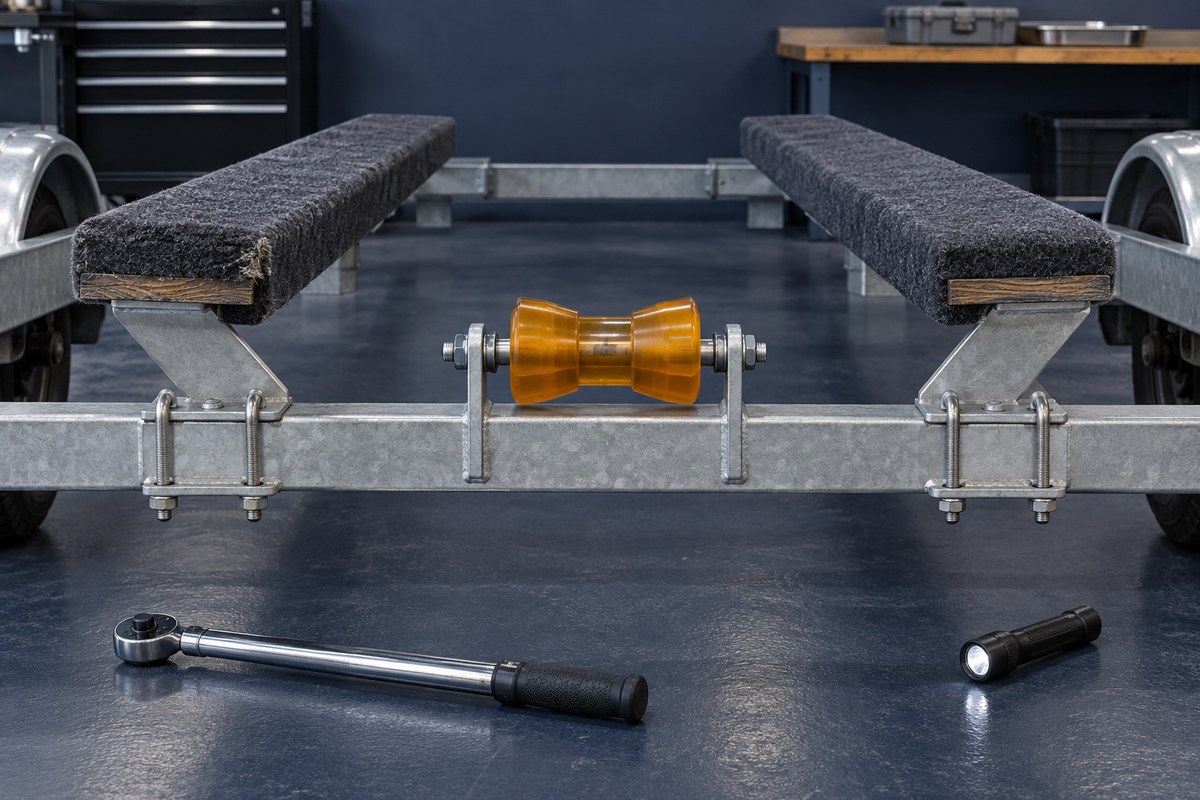
Roll each keel, wobble, and side roller by hand when the trailer is empty. It should rotate as designed without binding, excessive side play, a grinding feel, or a flat spot. Inspect the roller material for cracking, hardening, chunks missing, deep grooves, and distortion. Dark marks on the hull or an off-center wear band on the roller can point to misalignment.
Check shafts, washers, retaining rings, cotter pins, end caps, and brackets. A roller that appears sound can leave the trailer if a small retainer corrodes away. Inspect pivot bars and rocker assemblies for free movement, bent members, enlarged holes, worn bushings, and uneven articulation. Load Rite’s maintenance guidance calls for checking roller assemblies for free movement and lubricating them as necessary.
Lubricate only the points and with the product identified by the trailer manufacturer. Do not coat roller surfaces or apply lubricant where it can reach the hull, brakes, or tire tread. Replace seized or damaged components with parts matched by trailer model and VIN where the manufacturer uses model-year-specific hardware.
Examine brackets, U-bolts, and crossmembers
Inspect every bunk and roller bracket from both sides. Look for bends, fatigue cracks, elongated bolt holes, rust scale, loss of galvanizing, cracked welds, and hardware that has shifted. Surface discoloration and structural section loss are not the same; if corrosion depth or bracket strength is uncertain, replace or professionally evaluate the part.
Check U-bolts, bolts, locknuts, washers, and mounting plates. Threads should be serviceable and the hardware arrangement should match the manual. Do not reuse distorted prevailing-torque nuts or substitute ordinary hardware where the manufacturer specifies a particular grade, coating, locking method, or stainless component.
Use published torque values for the exact assembly. Tightening until a bracket visibly deforms can weaken the support or crush a frame member. After adjustment or replacement, mark positions, recheck alignment with the boat carefully loaded, and follow the manufacturer’s retorque schedule.
Extend the inspection to the crossmember and nearby trailer frame. A sound bunk attached to a cracked or badly corroded crossmember is not a sound support system. Load Rite recommends inspecting frames and axles for rust, damage, and fractures and replacing structural members that have been stressed beyond their intended range. The NHTSA towing safety guidance is a useful companion when the trailer goes back on the road.
Read the wear pattern on the boat and trailer
The hull can help diagnose the trailer. With the boat safely afloat or otherwise supported, inspect the usual contact areas for fresh scuffs, polished stripes, stress cracking, dents, or isolated pressure marks. Compare port and starboard sides. Uneven marks may indicate a shifted support, loading alignment problem, or a hull-support setup that needs professional correction.
Also look at the loading path. Deep gouges at a bunk end, a roller that carries a one-sided wear band, or repeated contact with a strake suggests the boat is not traveling onto the trailer as intended. Correct the cause rather than repeatedly replacing the damaged covering.
Prepare hull supports for winter storage
Once repairs are complete, let carpeted bunks and concealed areas dry thoroughly. Verify that the boat sits in its intended position, with the bow stop and winch arrangement correct and the transom supported as the trailer and boat manufacturers specify. Long-term storage does not justify adding unapproved blocks or moving supports to seemingly convenient locations.
Complete this checklist before storage:
- Inspect carpet or glide surfaces for wear, sharp edges, and exposed fasteners.
- Check bunk boards for straightness, soft spots, splitting, and damaged attachment holes.
- Rotate every roller and inspect material, shafts, retainers, and pivot bars.
- Examine brackets, U-bolts, plates, crossmembers, and welds for movement or corrosion.
- Confirm support positions against the trailer and boat guidance.
- Replace hardware with specified components and use published torque values.
- Recheck hull clearance around strakes, chines, fittings, transducers, and trim tabs.
- Rinse, dry, and document the final loaded position before storage.
Track bunk and roller service in BoatDuty
Add a BoatDuty maintenance entry with the trailer VIN and model, inspection date, bunk dimensions, covering or roller material, bracket locations, fastener specifications, torque values, and parts replaced. Photograph the empty support layout and the boat’s final loaded position. Note any hull marks, alignment changes, dealer recommendations, and the date for a loaded recheck.
These details are especially useful several seasons later, when a weathered board or roller needs replacement and the original setup is no longer obvious. A documented hull-support inspection helps preserve both the trailer and the boat it is meant to carry.