
Boat trailer tire maintenance is easy to postpone when the boat needs winterizing, but the last tow of the season still depends on sound tires. A trailer that travels only a few weekends each year can have plenty of tread and still need attention. Pressure loss, physical damage, and aging deserve a place on the fall checklist alongside the boat’s mechanical service.
This inspection is intended for owners preparing a recreational boat trailer for storage or another trip. Tire size, load requirements, inflation, wheel hardware, and storage procedures must match the particular trailer. Use its placard and manual together with the tire manufacturer’s instructions; there is no single pressure or replacement age appropriate for every boat trailer.
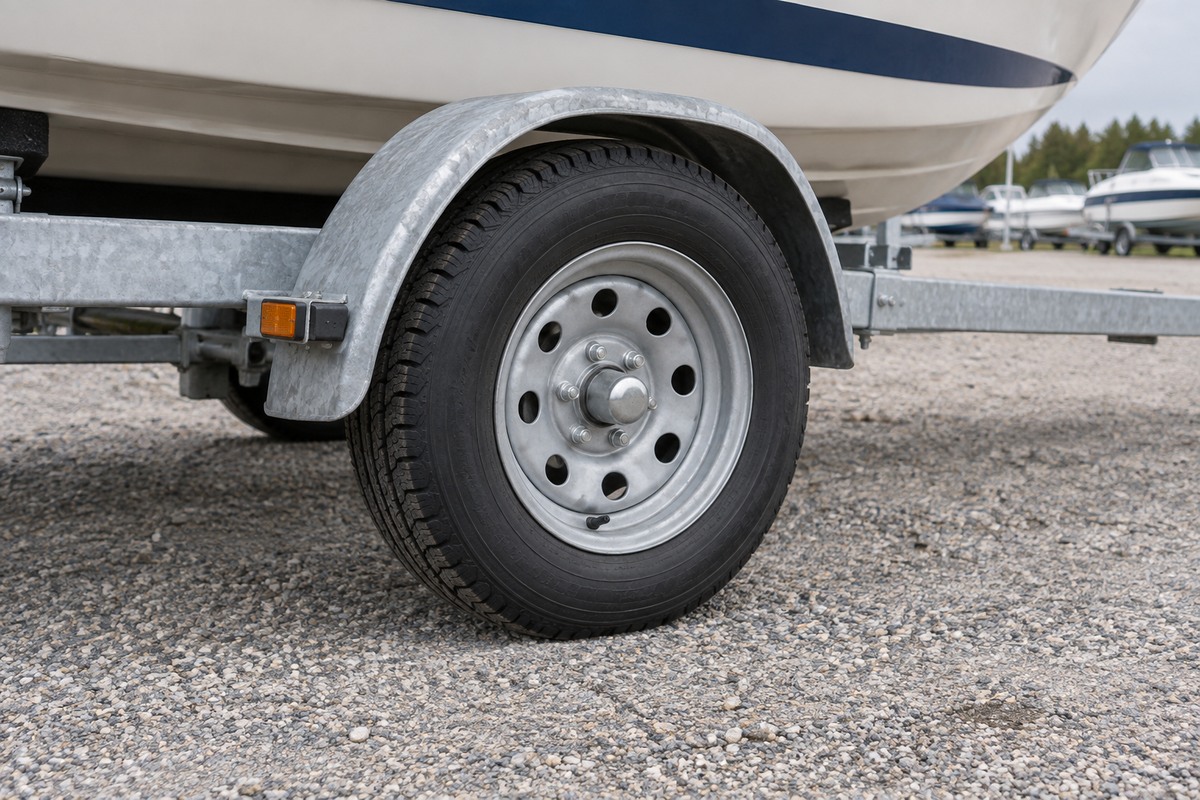
Identify the tires before ordering replacements
Record the make, model, size, service description, load range where marked, and full DOT Tire Identification Number for each tire. Identify positions consistently, such as left front and right rear on a tandem-axle trailer. Include the spare as its own entry.
The last four digits of a modern DOT date code identify the manufacturing week and year. The full code may appear on only one side, so a missing date on the outside does not mean the tire has no date marking. NHTSA explains date codes and the role of age in tire condition in its TireWise guidance.
Photograph the markings while they are readable. If the installed tires differ from the trailer’s specifications, resolve that with the trailer manufacturer or a qualified tire professional before assuming the existing setup is correct.
Measure cold tire pressure
Use a reliable pressure gauge rather than judging inflation by appearance. NHTSA defines a cold tire for its general guidance as one that has not been driven on for at least three hours. Measure before towing, and use the trailer manufacturer’s specified cold inflation pressure for the approved tire configuration. The tow vehicle’s door-jamb pressure is not the trailer’s specification.
Write down the measured value before adjusting it. Recording only “tires inflated” loses the information that might reveal a recurring leak. A tire that repeatedly falls below the others needs investigation rather than repeated topping up without a diagnosis.
Check the spare as well. Confirm its required pressure from the applicable instructions and whether it has any restrictions on use. An apparently unused spare can still age or lose pressure while mounted on the trailer.
Inspect tread and sidewalls in good light
Examine the visible tread and both sidewalls as access allows. Look for cuts, cracks, bulges, exposed material, embedded objects, and areas of uneven wear. Record where the defect appears and take a clear photograph. If access requires lifting the trailer, use its specified lifting and support procedure; do not crawl beneath an unsupported trailer.
Use a tread-depth gauge and compare more than one location. NHTSA identifies 2/32 inch as a tire replacement threshold in its general tire guidance, but adequate tread depth alone does not clear a tire with damage or aging concerns for continued use. Follow any stricter requirement applicable to your tires and use.
An unusual wear pattern is a reason to investigate the trailer as a system. Avoid assigning a cause from one photograph. Give the tire professional the pressure history, towing observations, and wear measurements so the inspection can address the actual problem.
Treat tire age as a separate question
A short towing season does not stop a tire from aging. NHTSA notes that storage, environmental exposure, and infrequent use matter, and that aging cannot be assessed simply by looking at a tire. Ask the tire manufacturer for its inspection and replacement guidance for your specific product rather than adopting a universal “replace every few years” rule.
If you discover a bulge, significant cracking, persistent pressure loss, or another suspicious condition, arrange professional evaluation before towing. A storage deadline is not a reason to make one more trip on a questionable tire.
Prepare the trailer for its storage location
Before parking, review the trailer and tire manufacturers’ storage instructions. Confirm the required pressure and any guidance on protecting the tires from environmental exposure. Do not deflate tires, add an arbitrary amount of extra pressure, or lift the loaded trailer onto improvised supports as a generic winterization shortcut.
Choose a location where you can reach the tires for periodic checks. Keep the valve stems accessible, and write down the storage-start readings. Recheck pressure and condition before the trailer moves again, even if the last inspection was completed only a few weeks earlier. NHTSA recommends monthly pressure checks, including the spare, in its general tire maintenance guidance.
Build a tire record you can compare in BoatDuty
Use BoatDuty to record the inspection date and each tire’s position, identification, date code, measured pressure, required pressure and its source, tread observations, and any repairs or replacements. Trailer mileage can be useful if you know it; engine hours do not measure tire use, so do not substitute one for the other.
When a shop replaces a tire, record the new tire’s details and the reason the old one was removed. That turns a receipt into a maintenance history you can use next season.
Fall boat trailer tire checklist
- Confirm the tire configuration against the trailer’s requirements.
- Record identification and date codes for every tire and the spare.
- Measure and record cold pressure before making adjustments.
- Inspect tread and sidewalls for damage or unusual wear.
- Investigate recurring pressure loss or towing vibration.
- Check the manufacturer’s age and storage recommendations.
- Resolve questionable conditions before towing.
- Log completed work and outstanding repairs in BoatDuty.
A useful tire inspection ends with measurements and decisions, not simply a glance at the tread. Taking those notes before storage makes the next departure easier to prepare for.
Supporting source: NHTSA TireWise — tire pressure, inspection, aging, date codes, and spare-tire guidance. This is general tire guidance; trailer-specific specifications remain controlling.